
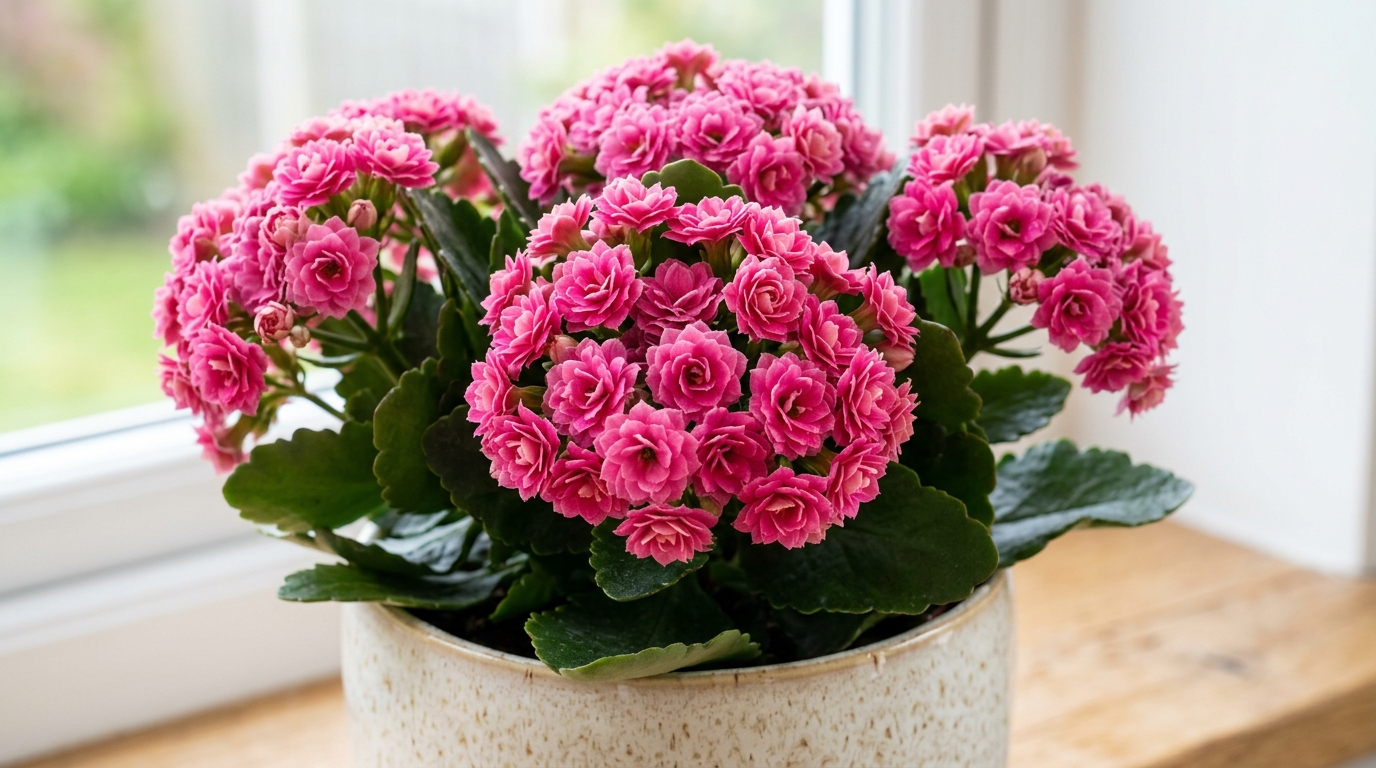
Variety Spotlight: The Calandiva Kalanchoe (often sold as the Rose Kalanchoe or Double Flaming Katy) is an extraordinary patented mutation of standard Kalanchoe blossfeldiana. While traditional Kalanchoes feature simple four-petaled flowers, Calandiva produces tightly layered blossoms with 26 to 32 velvety petals resembling miniature roses that last up to 8 full weeks. For baseline growing conditions, refer to our Flaming Katy care guide, and discover how to make Kalanchoe bloom again after double flowers fade.
When you spot a Calandiva Kalanchoe in a flower boutique, it is easy to mistake it for a miniature potted hybrid tea rose. With clusters of densely packed, ruffled petals in striking shades of crimson, blush pink, vivid coral, royal purple, and creamy white, Calandiva represents one of the greatest horticultural breeding achievements in succulent history.
Despite its luxurious, delicate floral appearance, Calandiva retains the indestructible succulent constitution of its Madagascan ancestors. Here is your definitive botanical care guide to cultivating, maintaining, and reblooming this magnificent double-flowered variety.
The History of Calandiva: A Fortunate Botanical Mutation
The Calandiva story began in 1998 in a commercial greenhouse in the Netherlands. Grower Leonardus van der Knaap discovered a spontaneous natural genetic mutation in a standard purple Kalanchoe blossfeldiana crop: instead of the species’ customary four single petals, this singular plant had transformed its stamens into additional petaloid whorls, creating a full double flower.
After four years of selective breeding and stability testing, the Calandiva series was patented and officially introduced to the international floral market in 2002. Today, it remains one of the world’s most sought-after indoor flowering succulents.
Comparison: Standard Kalanchoe vs. Calandiva
Understanding the botanical distinctions between standard Flaming Katy and the Calandiva cultivar helps you optimize your growing environment:
| Feature | Standard Kalanchoe Blossfeldiana | Calandiva (Rose Kalanchoe) |
|---|---|---|
| Petal Architecture | Single whorl with 4 distinct petals | Multiple overlapping whorls (26 to 32 petals) |
| Bloom Longevity | 4 to 6 weeks per cluster | 6 to 10 weeks (dense petals retain hydration longer) |
| Flower Sensitivity to Overhead Water | Moderate tolerance | Very high: water trapped in petals causes rapid gray mold (Botrytis) |
| Fertility & Seed Set | Readily produces viable seeds | Largely sterile (stamens modified into petals; propagate via cuttings) |
Pillars of Calandiva Care
1. Light: The Engine of Double Blooms
Calandiva requires abundant, bright indirect sunlight to sustain its energy-hungry double blossoms. An east-facing or west-facing window receiving filtered sunshine is ideal. In low-light corners, flower buds abort before opening, and the thick succulent leaves turn dull pale green.
2. The Soak-and-Dry Watering Rule
Because Calandiva stores significant water reserves inside its fleshy, scalloped leaves, overwatering is its number-one killer. Always employ the soak-and-dry method:
- Insert your finger 2 inches into the potting medium. Only water if the soil feels completely dry and bone-dry to the touch.
- Always water the soil directly at the base of the pot. Never spray or mist Calandiva flowers; moisture trapped inside dense double petals triggers destructive fungal rot within 48 hours.
- Empty the drainage saucer immediately. Calandiva roots perish quickly if submerged in standing water.
3. Well-Draining Substrate
Never plant Calandiva in standard peaty indoor potting soil. Combine 60% high-quality cactus and succulent potting mix with 40% perlite or coarse horticultural pumice. This provides the fast drainage and aeration essential for delicate succulent root hairs.
How to Force Calandiva to Rebloom (The Photoperiod Secret)
Like its parent species, Calandiva is a short-day (photoperiodic) plant. In nature, it only initiates floral buds when the nights become longer than the days in autumn. Once your plant finishes its spring bloom and you deadhead the spent stalks, follow this 6-week photoperiod protocol in early autumn:
- For 6 consecutive weeks, provide the plant with 14 hours of continuous, pitch-black darkness every single night (e.g., from 6:00 PM to 8:00 AM). Place it in a dark closet or cover it with a breathable opaque cardboard box.
- During the remaining 10 hours of daylight, provide bright, indirect sunlight.
- Reduce watering by 50% and suspend all fertilizer during this dark dormancy period.
- At the end of 6 weeks, tiny green flower bud clusters will emerge at every branch terminal. Return the plant to normal bright light and watch a spectacular new bouquet of miniature roses unfold!
Frequently Asked Questions
Are Calandiva flowers natural or artificially dyed?
Calandiva flower colors are 100% natural genetic traits resulting from selective breeding. They are not dyed, and when your plant reblooms at home, it will produce the exact same vibrant color palette.
Can I propagate Calandiva from seeds?
Because Calandiva’s reproductive organs (stamens) were transformed into petals during the mutation, the flowers rarely produce viable seeds. Calandiva must be propagated vegetatively through stem cuttings to preserve its double-flowered genetics.
Why are the inner petals of my Calandiva turning brown while buds are still opening?
This is almost always caused by overhead watering or high ambient humidity without adequate air circulation. Water droplets trapped inside the tightly packed 32-petal flower heads cause Botrytis cinerea (gray petal blight). Snip off affected blooms and ensure water only touches the soil.