
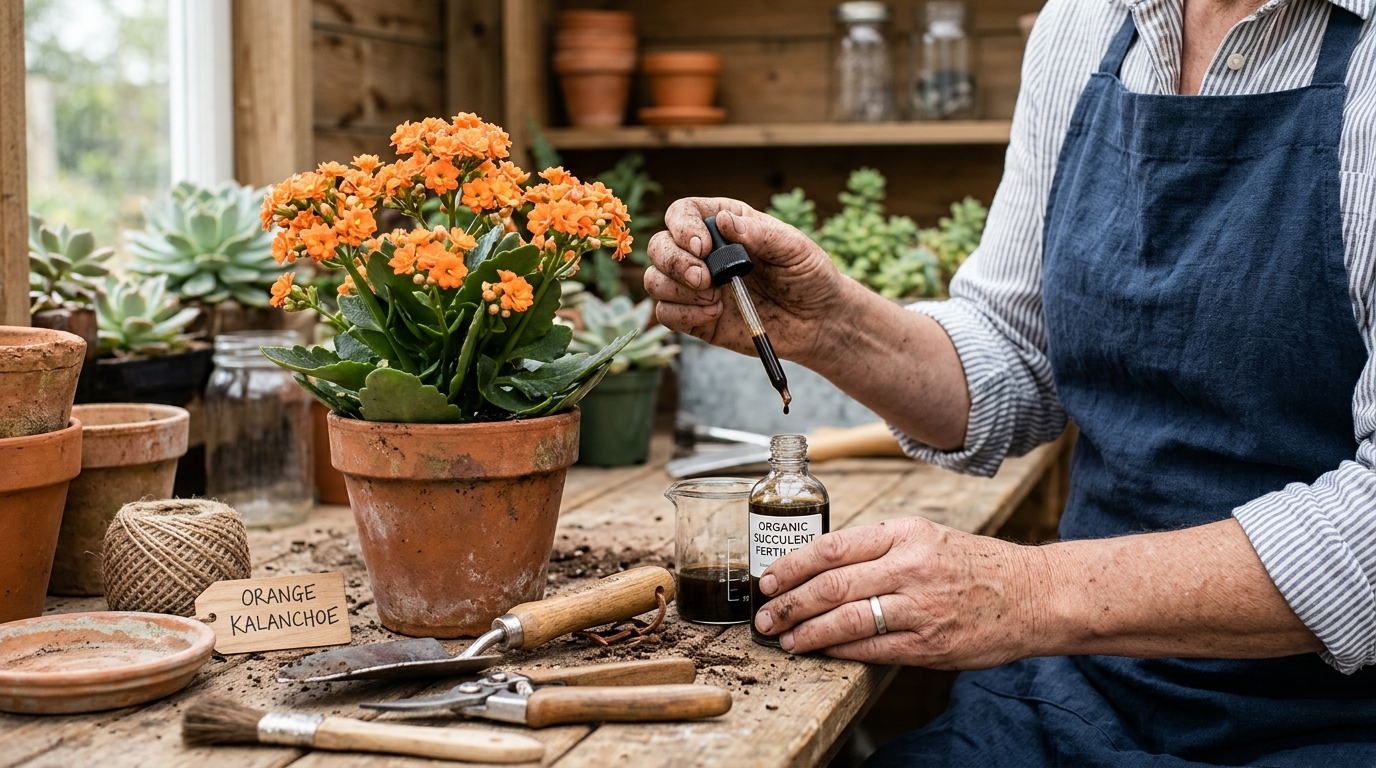
Nutrient Rule: Unlike heavy-feeding tropical houseplants like monsteras or calatheas, Kalanchoe blossfeldiana is an arid succulent with modest nutrient needs. High-nitrogen fertilizers cause rapid, floppy green foliage growth at the expense of flower buds. The ideal formula is a balanced, water-soluble fertilizer diluted to half-strength applied only during the spring and summer active growing seasons. Combine proper feeding with the best soil mix for Kalanchoe and baseline habits in our Flaming Katy care guide.
Few things are more frustrating for a houseplant enthusiast than caring for a healthy-looking Kalanchoe that produces nothing but giant green leaves and refuses to rebloom. In nine out of ten cases, this is directly caused by improper fertilization, either applying high-nitrogen plant food or feeding at the wrong time of the seasonal cycle.
In this comprehensive botanical guide, you will learn the exact nutritional requirements of Kalanchoe, how to decode N-P-K ratios for succulent health, and how to implement a seasonal feeding schedule that guarantees dense, vibrant floral displays.
Understanding N-P-K Ratios for Flowering Succulents
Every commercial fertilizer package displays three prominent numbers representing the percentage of primary macronutrients by weight: N (Nitrogen), P (Phosphorus), and K (Potassium).
- Nitrogen (N): Stimulates chlorophyll production and vegetative foliage growth. While essential for building strong leaves in early spring, excessive nitrogen softens succulent cell walls and completely inhibits flower bud development.
- Phosphorus (P): Drives root development, flower initiation, and bud blooming. A formula with adequate phosphorus is crucial when preparing Kalanchoes for their flowering phase.
- Potassium (K): Regulates water pressure inside succulent vacuoles, strengthens disease resistance, and fortifies cell walls against temperature stress.
The Ideal Formulation: For general vegetative maintenance, a balanced 10-10-10 or 20-20-20 water-soluble houseplant fertilizer diluted to half the manufacturer’s recommended strength is best. In late summer when buds are initiating, switching to a high-phosphorus bloom booster (such as a 10-20-10 or 5-10-5 formula) provides targeted support for abundant floral whorls.
Seasonal Feeding Schedule
Timing your fertilizer applications to match the plant’s natural metabolic rhythm is the secret to healthy growth without salt toxicity:
| Season / Phase | Recommended N-P-K | Dilution Strength | Application Frequency |
|---|---|---|---|
| Spring (Post-prune vegetative surge) | Balanced 10-10-10 or 12-12-12 | Half strength (1/2 tsp per gallon) | Once every 3 to 4 weeks |
| Summer (Full foliage maturity) | Balanced 10-10-10 or Cactus feed | Half strength | Once every 4 weeks |
| Late Summer / Early Autumn (Bud initiation) | Bloom booster (e.g. 10-20-10) | Half to quarter strength | Twice total, 3 weeks apart |
| Autumn Dark Phase & Winter Rest | NONE (Zero fertilizer) | N/A | Suspended completely until spring |
Organic vs. Synthetic Fertilizers: Which Is Better?
Both types have distinct advantages depending on your growing style:
- Liquid Synthetic Fertilizers: Offer precise control over N-P-K ratios and are immediately bio-available. Ideal for quick corrections. Always pre-moisten the soil with plain water before applying synthetic fertilizer to prevent root scorch.
- Organic Soil Amendments (Worm Castings & Compost Tea): Worm castings gently top-dressed on the soil surface provide a slow-release, non-burning supply of micronutrients (calcium, magnesium, iron) and beneficial soil microbes that enhance nutrient uptake naturally.
Signs of Over-Fertilization and How to Flush the Soil
Applying fertilizer too frequently or at full concentration causes mineral salts to accumulate in the potting container. Key warning signs include:
- A brittle, white crust of mineral salts forming on the soil surface or terracotta pot rim.
- Crispy, brown, burned leaf tips and margins on lower foliage.
- Sudden leaf drop while the soil is moist.
How to Flush: Place the pot in a sink or shower. Slowly pour room-temperature water equal to twice the volume of the pot through the soil, letting it drain completely out the bottom. This leaches accumulated fertilizer salts away from the root zone. Allow the soil to dry thoroughly before returning to a regular watering routine.
Frequently Asked Questions
Should I fertilize a Kalanchoe while it is actively flowering?
No. Once flower buds show color and begin opening, fertilizing will not make the flowers bigger or last longer. In fact, sudden nutrient spikes during full bloom can cause flowers to fade prematurely. Suspend all fertilizer while your plant is in bloom.
Can I use standard tomato or orchid fertilizer on a Kalanchoe?
Diluted orchid or tomato fertilizer (high in phosphorus and potassium) can be used effectively during the late-summer bud-setting phase, provided you dilute it to 1/4 strength. However, general succulent and cactus fertilizer remains the safest all-round option.
Why did my Kalanchoe develop giant green leaves but no flowers after feeding?
This classic symptom indicates nitrogen excess. High nitrogen suppresses floral flowering hormones and redirects all cellular energy into massive vegetative leaves. Flush the potting soil with plain water, move the plant into brighter indirect light, and switch to a high-phosphorus formula next season.