
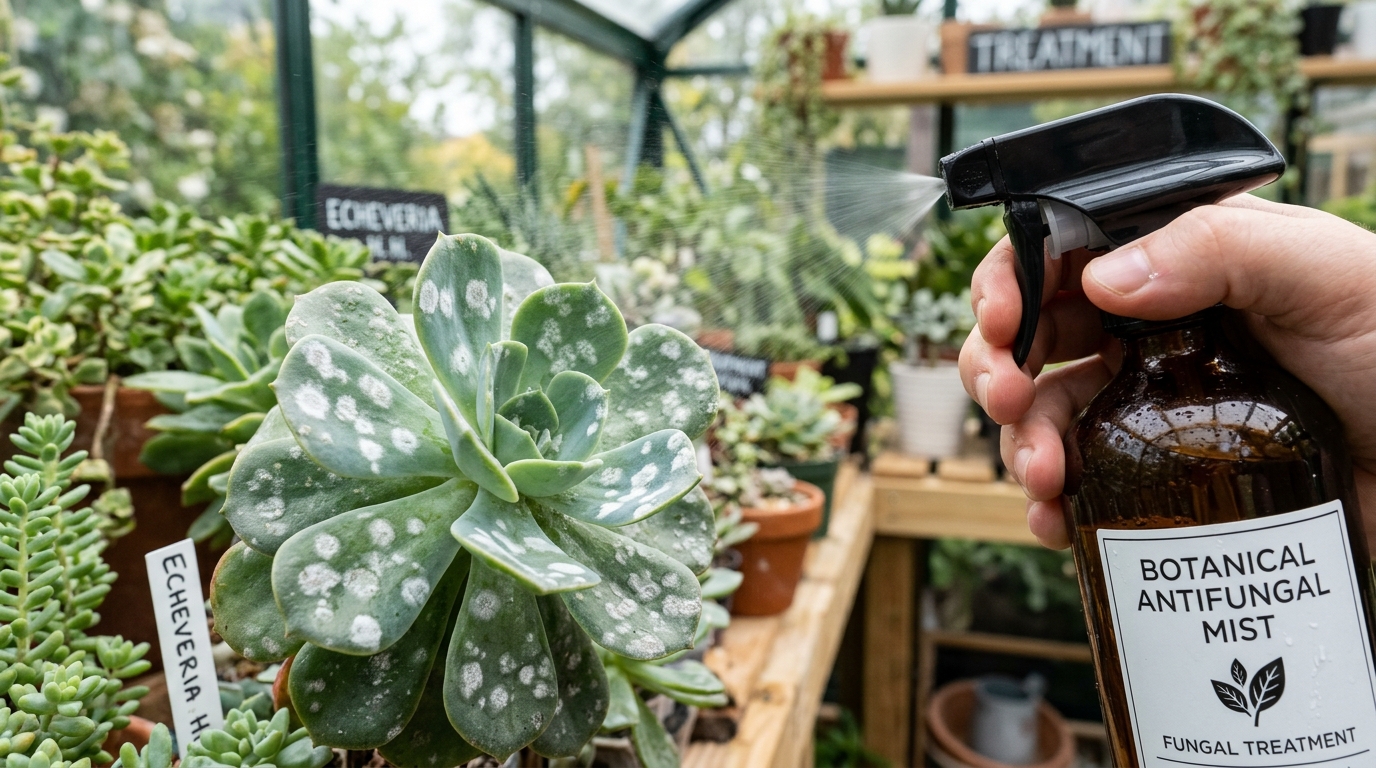
Diagnostic Alert: Powdery mildew (caused primarily by fungi in the order Erysiphales) is the most destructive foliage disease affecting Kalanchoe blossfeldiana. Left untreated, microscopic fungal hyphae penetrate the waxy succulent cuticle, robbing cells of moisture, causing severe leaf curling, blossom drop, and eventual systemic defoliation. Early diagnosis and gentle non-phytotoxic treatments are vital. If leaves become discolored or droop, check our diagnostic chart on Kalanchoe leaves turning yellow, and keep plants robust with our Flaming Katy care guide.
One morning, you glance at your beloved Flaming Katy and notice what looks like a dusting of talcum powder or fine flour on several upper leaves. Within a few days, the spots expand into pale, fuzzy patches, and the affected foliage begins puckering, yellowing, and drying up.
You are dealing with powdery mildew, a common fungal condition that thrives in the still, warm air of indoor homes. Because succulent leaves are sensitive to chemical burns, using the wrong fungicide can cause more damage than the fungus itself. Here is your definitive botanical guide to correctly identifying white spots on Kalanchoe and treating them safely.
Differential Diagnosis: Is It Really Powdery Mildew?
Before applying any treatment, make sure you are not confusing powdery mildew with other common indoor plant phenomena:
| White Spot Type | Visual Appearance & Texture | Touch / Rub Test | Underlying Cause |
|---|---|---|---|
| Powdery Mildew | Circular, dusty white/gray powder on leaf surface | Rubs off easily under light finger pressure, leaving damaged tissue below | Fungal infection (Podosphaera / Erysiphe) |
| Mealybugs | Cottony, fluffy white clusters in leaf axils and crevices | Sticky, reveals small pinkish insect when swabbed with alcohol | Sap-sucking insect pest (Pseudococcidae) |
| Hard Water Mineral Spots | Flat, chalky white water droplet outlines | Does not rub off easily with dry finger; dissolves with a damp cloth | Calcium / magnesium residue from overhead tap water |
| Oedema (Edema) | Raised, corky, wart-like white or tan bumps on underside | Cannot be rubbed off; integral part of swollen leaf cellular structure | Physiological disorder from overwatering in humid air |
What Triggers Powdery Mildew on Kalanchoes?
Contrary to popular belief, powdery mildew does not require dripping wet leaves to germinate. In fact, standing water actually inhibits spore germination! The fungus thrives in an environment with:
- Stagnant Air Circulation: Rooms without natural airflow allow fungal spores to settle undisturbed on leaf surfaces.
- Moderate Temperatures: Optimal fungal proliferation occurs between 60°F and 80°F (15°C to 27°C).
- High Relative Humidity: Humidity above 70% accelerates spore germination, especially during dark nighttime hours.
- Low Light Conditions: Sunlight’s natural ultraviolet spectrum inhibits fungal growth; plants kept in dim corners are vastly more susceptible.
Safe and Effective Treatment Protocols
Step 1: Immediate Quarantine and Physical Removal
Isolate the infected plant from other houseplants immediately to stop airborne spore transmission. Take clean pruning snips sterilized with 70% alcohol and clip off any heavily coated leaves that are already yellowing or severely distorted. Place diseased foliage directly into a sealed plastic bag and discard.
Step 2: Gentle Potassium Bicarbonate Solution (The Gold Standard)
Potassium bicarbonate is an organic, horticultural-grade fungicide that disrupts the cell walls of powdery mildew without harming succulent tissue:
- Mix 1 teaspoon of potassium bicarbonate (or food-grade sodium bicarbonate / baking soda) and 1/2 teaspoon of pure horticultural horticultural oil (or light mineral oil) into 1 quart of lukewarm distilled water.
- Spray lightly over all affected stems and leaves, ensuring complete coverage including the undersides.
- Apply in the early morning or evening. Never spray a succulent under direct intense sunlight, as the oil component can cause phytotoxic leaf sunburn.
Step 3: Diluted Neem Oil (Organic Preventative)
Cold-pressed pure neem oil contains azadirachtin and hydrophobic clarified extracts that smother fungal spores and deter insect pests simultaneously. Mix 1 teaspoon of pure neem oil and 1/3 teaspoon of mild unscented liquid Castile soap per quart of water. Test on a single leaf 24 hours prior to full application to ensure your specific cultivar shows no sensitivity.
Long-Term Cultural Prevention
- Install a Gentle Oscillating Fan: Just 1 to 2 hours of gentle air movement daily completely disrupts spore settlement.
- Adopt Bottom-Watering: Place the pot in a basin of water for 20 minutes so water enters through drainage holes, keeping upper foliage completely dry.
- Space Plants Generously: Ensure leaves do not touch neighboring plant pots.
- Maximize Bright Indirect Sunlight: Natural light keeps the outer leaf cuticle thick, firm, and impervious to fungal penetration.
Frequently Asked Questions
Can powdery mildew spread from my Kalanchoe to other houseplants?
Yes. While different species of powdery mildew fungi have preferred host families, other Crassulaceae succulents (such as Jade plants, Echeverias, and Sedums) and begonias can be readily cross-infected in stagnant indoor conditions. Always isolate the infected plant promptly.
Why did my Kalanchoe leaves get brown chemical burns after spraying dish soap?
Commercial dish soaps contain harsh synthetic degreasers and surfactants designed to dissolve heavy kitchen grease. When applied to succulents, these detergents strip away the protective waxy epicuticular wax layer, causing sudden tissue collapse and brown chemical burns. Only use gentle, organic vegetable Castile soap.
Will the white powdery mildew spots vanish immediately after treatment?
A successful fungicide treatment kills the living fungal mycelium within 24 to 48 hours, causing it to turn from bright white to dull gray or brown. However, leaves that suffered extensive epidermal puncture will retain minor corky scar spots until new healthy foliage grows in to replace them.