
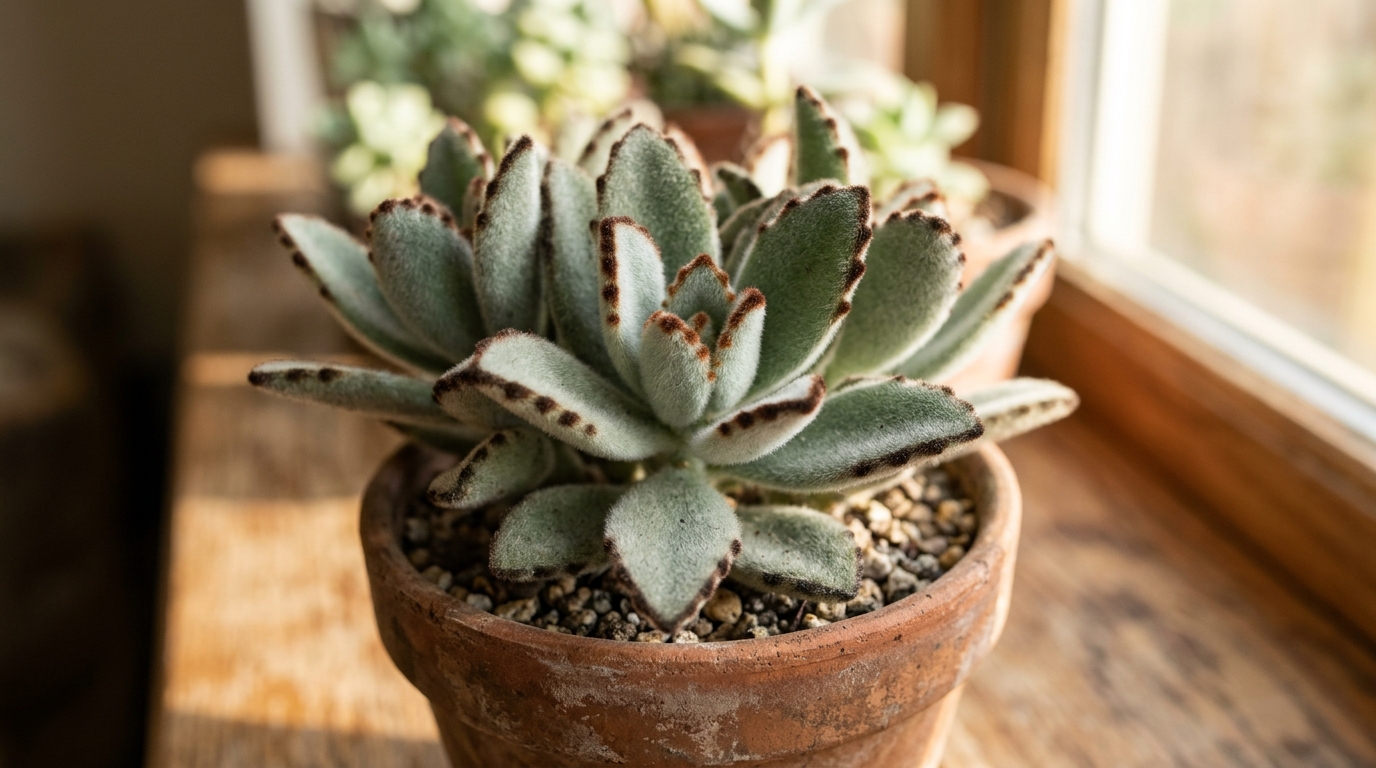
Variety Profile: Kalanchoe tomentosa, affectionately known as the Panda Plant or Chocolate Soldier, is a Madagascan shrub succulent famed for its soft, plush silvery-white foliage tipped with reddish-brown to dark chocolate spots. Its velvety coat is made of microscopic protective trichomes designed to thrive in arid desert winds. Just like the flowering varieties in our Flaming Katy care guide, Panda Plants require sharp drainage with a gritty succulent soil mix and infrequent hydration via our Kalanchoe watering guide.
Among the hundreds of species within the Kalanchoe genus, few capture the heart as instantly as the Panda Plant (Kalanchoe tomentosa). Instead of the smooth, glossy green leaves typical of Kalanchoe blossfeldiana, the Panda Plant is cloaked in a luxurious layer of dense, silvery hairs that give the plant a touchable, felt-like texture.
Despite its delicate, teddy-bear appearance, Kalanchoe tomentosa is a rugged, drought-resilient succulent. In this comprehensive variety guide, you will learn the botanical secrets of its fuzzy foliage, how to intensify its dark chocolate markings, and the vital watering mistakes you must avoid.
The Science of Fuzzy Leaves: What Are Trichomes?
The velvety texture of the Panda Plant is not just ornamental, it is a brilliant evolutionary adaptation for survival in the harsh, arid granite rocks of central Madagascar. The leaves are covered in thousands of tiny, specialized hairs called trichomes.
These trichomes serve three critical botanical functions:
- Moisture Retention: The dense hairy network traps a boundary layer of humid air directly against the leaf surface, dramatically reducing transpiration (water loss) under baking tropical sun.
- Natural Solar Reflection: The silvery hairs bounce harsh ultraviolet radiation away from vulnerable chlorophyll cells, acting as natural plant sunscreen.
- Dew Harvesting: In arid microclimates with sparse rainfall, morning fog condenses on the hair tips and trickles down into the root zone.
Panda Plant Cultural & Care Requirements
Cultivating a thriving Panda Plant requires tailoring your indoor environment to mimic its native Madagascan granite outcrops:
| Care Parameter | Ideal Condition | Common Danger to Avoid |
|---|---|---|
| Light Exposure | Bright indirect light + 2-4 hours morning sun | Dim light causes leggy stretching and fades brown spots to pale gray |
| Watering Method | Bottom watering or base watering; dry 100% between soaks | Never spray or pour water onto fuzzy leaves (traps moisture, causing rot) |
| Potting Substrate | 50% cactus potting soil + 50% coarse perlite or pumice | Heavy moisture-retentive peat moss causes fungal root collapse |
| Temperature Range | 60°F to 80°F (15°C to 27°C) | Frost sensitive; temperatures below 45°F (7°C) trigger leaf drop |
The Critical Rule: Never Wet the Leaves
While smooth-leaved houseplants enjoy an occasional foliage wipe or rinse, water droplets are the greatest enemy of the Panda Plant. Because of the microscopic trichomes, water droplets cannot easily evaporate or run off. Instead, moisture sits trapped against the waxy epidermal cuticle, acting as a petri dish for fungal spores.
Always practice bottom-watering: place the pot into a basin of water for 15 to 20 minutes, allowing moisture to wick upward through the drainage hole, leaving the furry crown bone-dry.
How to Intensify the Chocolate-Brown Markings
The distinctive dark chocolate stitching along the serrated leaf margins is driven by anthocyanin pigments. When a Panda Plant receives adequate, bright filtered sunlight, its cells produce rich brown and burgundy pigments to shield the leaf margins from intense rays.
If your Panda Plant’s brown tips begin turning pale beige or vanishing entirely, your plant is signaling that it needs brighter light. Gradually acclimate it to a sunny east-facing or south-facing windowsill, and watch the bold chocolate edges return within 2 to 3 weeks.
Propagating Panda Plant from a Single Leaf
Panda Plants are remarkably easy to propagate vegetatively from mature leaves:
- Gently twist a healthy, plump lower leaf from the main stem, ensuring a clean break with the basal node intact.
- Place the leaf on a dry paper towel in a bright, shaded room for 3 to 4 days until the wound callouses over.
- Lay the calloused leaf flat on top of a tray filled with dry cactus soil mix. Do not bury it!
- Within 2 to 3 weeks, tiny pink roots and an adorable miniature furry rosette will emerge directly from the calloused base. Lightly mist the soil around the roots once they establish.
Frequently Asked Questions
What is the difference between Panda Plant and Chocolate Soldier?
‘Chocolate Soldier’ is a popular cultivated variety (cultivar) of Kalanchoe tomentosa. While the standard Panda Plant has silvery-white leaves with intermittent dark brown spots, ‘Chocolate Soldier’ features longer, narrower leaves with an almost continuous, rich chocolate-golden brown border that extends along the entire leaf margin.
Why is my Panda Plant losing its lower leaves?
It is natural for a Panda Plant to occasionally shed its oldest bottom leaves as the main stem matures and becomes semi-woody. However, if multiple leaves drop simultaneously and feel soft or translucent, it is a clear warning sign of overwatering and root rot. If they drop dry and shriveled, the plant has been kept bone-dry for too long.
Does the Panda Plant bloom indoors?
While mature Panda Plants bloom readily in nature, indoor flowering is rare. When it does bloom in spring or summer, it sends up a tall spike bearing small, bell-shaped, fuzzy rust-colored flowers with green-yellow throats. Panda Plants are primarily grown for their extraordinary year-round velvet foliage.
Is Kalanchoe tomentosa safe around pets?
Like all members of the Kalanchoe genus, the Panda Plant contains cardiac glycoside toxins (bufadienolides) that can cause gastrointestinal upset, vomiting, diarrhea, and abnormal heart rates in dogs and cats if ingested. Keep this plant placed safely on high shelves away from curious pets.