
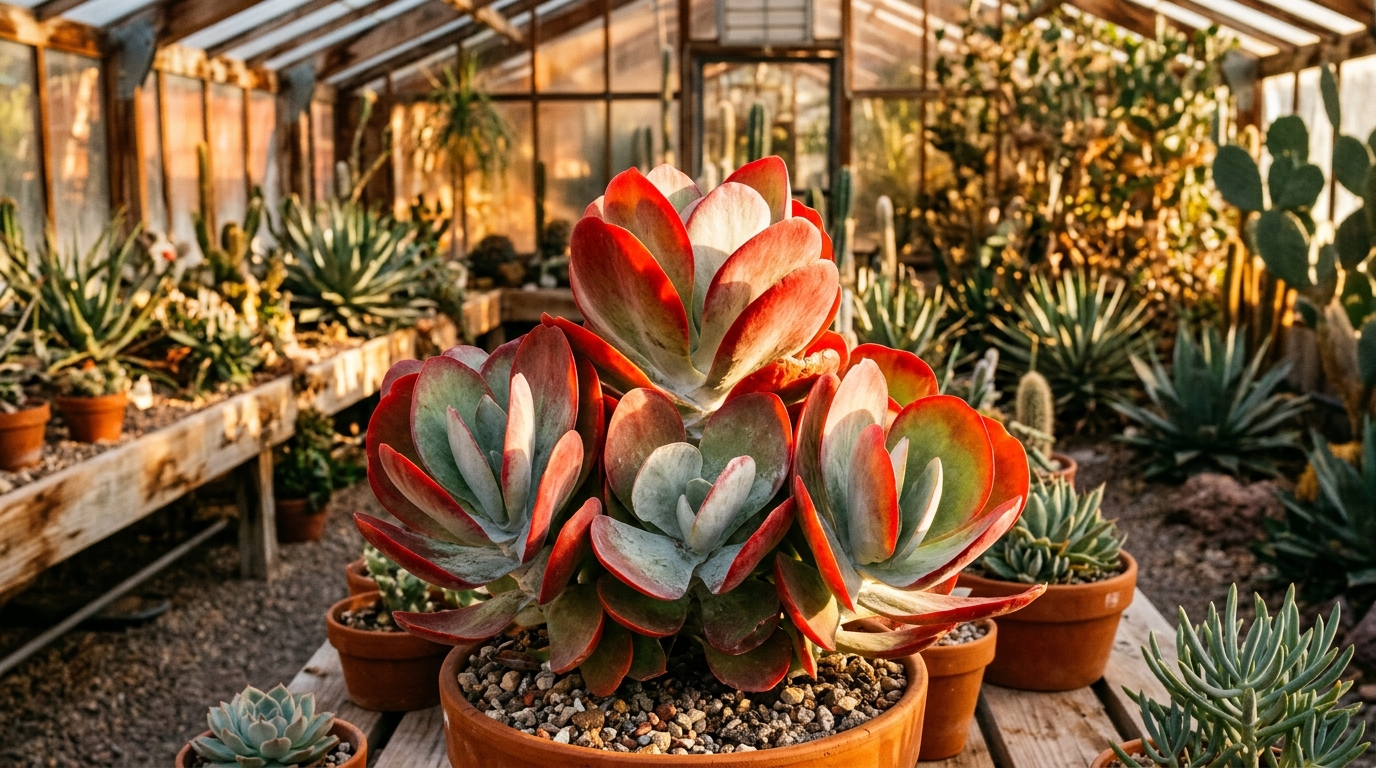
Variety Profile: Kalanchoe luciae, commonly called the Paddle Plant or Flapjacks, is a dramatic African succulent admired for its enormous, flattened rounded leaves that stack tightly like pancakes. When exposed to bright direct sunlight and cool autumn temperatures, the leaf margins ignite in a sensational fiery crimson hue. Sharing hardiness with our core Flaming Katy care guide, you can easily multiply paddle succulents using our tutorial on how to propagate Kalanchoe.
If you are looking for an architectural statement succulent that commands immediate attention, the Paddle Plant (Kalanchoe luciae) is unparalleled. With giant, rounded foliage overlapping like stacked plates, this plant looks like modern sculpture brought to life.
However, many plant enthusiasts purchase a vibrant red Paddle Plant from a greenhouse, only to watch it fade into a dull, flat green indoors within a few months. In this expert variety guide, you will discover the botanical mechanism behind its famous crimson glow, learn how to protect its delicate white powdery coating, and master long-term care.
The Great Botanical Mix-Up: Kalanchoe luciae vs. Kalanchoe thyrsiflora
In nurseries and home improvement stores across the globe, almost every Paddle Plant is mistakenly labeled as Kalanchoe thyrsiflora. Botanically, however, 99% of all commercially sold Paddle Plants are actually Kalanchoe luciae.
| Botanical Feature | Kalanchoe luciae (True Paddle Plant) | Kalanchoe thyrsiflora (Rare Botanical Species) |
|---|---|---|
| Leaf Coloration in Sun | Turns brilliant fiery scarlet / crimson red | Remains chalky jade-green with faint brownish-red margins |
| Flower Shape & Color | Pale white to faint yellowish, urn-shaped blossoms | Bright golden-yellow, strongly sweet-scented cylindrical flowers |
| Commercial Availability | Widely available everywhere in garden centers | Extremely rare outside botanical specialty collections |
The Secret to Bright Red Paddle Leaves: Environmental Stress
The intense red coloration of Kalanchoe luciae is not caused by fertilizer, it is an adaptive plant pigment response. When the plant experiences beneficial environmental stress, it manufactures large quantities of anthocyanins to protect its chlorophyll cells.
To achieve and maintain fiery red leaves:
- Maximize Direct Sunlight: The plant needs at least 4 to 6 hours of direct sun daily. Indoors, place it directly on an unobstructed south-facing windowsill.
- Cool Night Temperatures: A noticeable temperature drop in autumn (between 50°F and 60°F / 10°C to 15°C) dramatically accelerates anthocyanin synthesis.
- Controlled Drought: Slightly extending the dry interval between waterings encourages the red pigmentation to spread across the entire leaf blade.
Farina: The White Powdery Sunscreen (Never Wipe It Off!)
You may notice a chalky, powdery white film coating your Paddle Plant’s leaves. Beginners often confuse this with powdery mildew and attempt to wash or wipe it away. Do not touch it!
This natural coating is called epicuticular wax or farina. It serves as waterproof armor, protects against sunburn, and prevents fungal spores from adhering to the leaf surface. Once farina is rubbed off by fingers, it rarely regenerates on that leaf.
Monocarpic Bloom Cycle: What Happens When It Flowers?
After several years of vigorous growth, a mature Paddle Plant will send up an enormous 2 to 3-foot flower stalk packed with pale blossoms in late winter. Kalanchoe luciae is monocarpic, meaning the central rosette that blooms will naturally wither and die after flowering concludes.
Do not panic! Before the mother plant dies, it expends its energy producing numerous healthy miniature offsets (pups) around its base. Once the central bloom spike fades, gently separate these pups and repot them into fresh cactus soil to continue the plant’s legacy.
Frequently Asked Questions
Why are my Paddle Plant’s leaves curling downward and turning pale green?
Downward curled, pale green leaves are a classic symptom of light starvation (etiolation). In insufficient light, the leaves droop downward to expand surface area for light capture. Move your plant into direct sunlight or under a high-intensity full-spectrum grow light.
Can I prevent my Paddle Plant from dying after it flowers?
You can prolong the mother plant’s life by cutting off the emergent flower stalk as soon as it appears. However, because monocarpic flowering is hormonally driven, the plant will eventually complete its lifecycle while shifting its full vitality into producing vigorous basal offsets.
How often should I water a Paddle Plant?
During spring and summer, water deeply once every 10 to 14 days, allowing the potting medium to dry out completely between waterings. In winter, reduce watering to once every 3 to 4 weeks. Always check that the soil is bone-dry before adding water.