
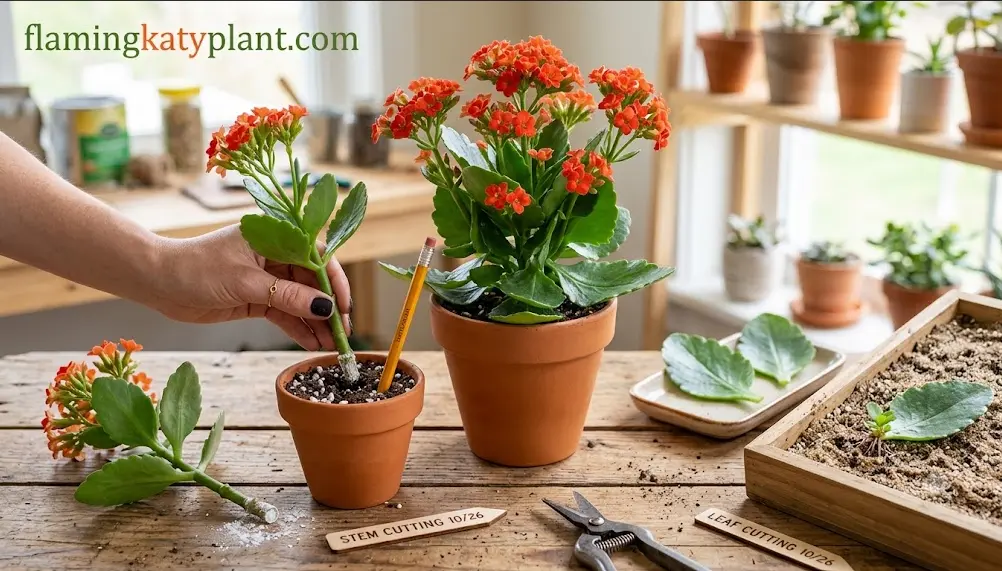
If you’ve ever looked at your Kalanchoe blossfeldiana — better known as Flaming Katy — and thought “I wish I had ten of these,” good news: you basically already do. This little succulent is one of the easiest houseplants to multiply, and you don’t need a green thumb, rooting hormone, or any fancy equipment. Just a healthy plant, a bit of patience, and about ten minutes of your time.
In this guide, we’ll walk through both ways to propagate Kalanchoe — leaf cuttings and stem cuttings — so you can pick whichever fits your plant (and your patience level) best.
Why Propagate Your Kalanchoe?
Before we get into the how, a quick word on why it’s worth doing:
- It’s free plants. Every cutting that roots is a new Kalanchoe you didn’t have to buy.
- It rescues leggy growth. If your plant has stretched out from low light, propagation lets you start fresh with a compact new plant.
- It’s genuinely satisfying. Watching roots appear on something you grew from a single leaf never really gets old.
- Great gifts. A rooted Kalanchoe cutting in a small pot is a lovely, low-effort gift for plant-loving friends.
What You’ll Need
Nothing exotic here — most of this is probably already in your home:
- A healthy, mature Kalanchoe plant (avoid ones that are stressed, wilting, or freshly repotted)
- A clean, sharp pair of scissors or a knife
- A small pot or tray with well-draining soil (a cactus/succulent mix works perfectly)
- A shallow dish of water (optional, for the water-rooting method)
- Patience — most cuttings take 2 to 4 weeks to root
Method 1: Propagating Kalanchoe from Leaf Cuttings
Leaf propagation is the gentlest method and a great option if you don’t want to cut into the main plant.
- Choose a healthy leaf. Pick a plump, undamaged leaf from lower on the plant — these tend to root more reliably than young leaves near the top.
- Remove it carefully. Gently twist or wiggle the leaf side to side until it detaches cleanly from the stem. You want the full leaf, including the base — a torn leaf is much less likely to root.
- Let it callus. Set the leaf somewhere warm and out of direct sun for 1–2 days. This lets the cut end dry out and form a callus, which helps prevent rot once it’s in soil.
- Place it on soil. Lay the leaf flat on top of moist, well-draining succulent soil, with the cut end lightly touching the surface. There’s no need to bury it.
- Wait and mist. Lightly mist the soil every few days to keep it barely damp — not wet. In 2–3 weeks, you should see tiny roots, followed by a miniature rosette growing from the base of the leaf.
- Separate once established. Once the baby plant has a few small leaves of its own and the original leaf has shriveled, it’s ready to be potted on its own.
Method 2: Propagating Kalanchoe from Stem Cuttings
Stem cuttings root faster than leaves and are the better choice if you’re trying to fix a leggy, overgrown plant.
- Select a stem. Look for a healthy stem, roughly 3–4 inches long, ideally with a few leaves on it.
- Make a clean cut. Using clean scissors, cut just below a leaf node (the point where a leaf meets the stem — this is where new roots will form).
- Remove the lower leaves. Strip off any leaves from the bottom inch or two of the cutting, so nothing is buried in soil or sitting in water.
- Let it callus. Just like with leaf cuttings, leave the stem to dry for 24–48 hours before planting. Skipping this step is the most common cause of rot.
- Root it your way. You have two options here:
- Soil: Insert the callused end into slightly moist succulent soil, about an inch deep, and place it somewhere bright with indirect light.
- Water: Suspend the cutting so the bottom node sits just above (or barely touching) a shallow dish of water. Roots typically appear within 1–2 weeks.
- Transplant if needed. If you rooted in water, move the cutting to soil once roots are about an inch long — this gives it the best long-term start.
Caring for New Kalanchoe Cuttings
Once your cutting is rooted and potted, treat it like a young plant rather than a mature one:
- Light: Bright, indirect light. Skip direct afternoon sun until it’s more established.
- Watering: Water only when the top inch of soil is dry — new roots rot easily in soggy soil.
- Humidity & temperature: Normal room conditions are fine; no need for a humidity dome.
- Fertilizing: Hold off for the first 6–8 weeks. Let it focus on rooting before pushing new growth.
Within a couple of months, your cutting should look like a proper little Kalanchoe, ready for the same care as its parent plant.
Common Mistakes to Avoid
- Skipping the callus step. Planting a fresh, uncallused cut almost always leads to rot — this is the #1 reason propagation fails.
- Overwatering. Kalanchoe cuttings are succulents at heart; “barely damp” soil is the goal, not wet.
- Using a damaged or torn leaf. A leaf that snapped rather than pulled cleanly rarely roots successfully.
- Low light. Cuttings need bright, indirect light to root and grow — a dim corner will slow (or stall) the whole process.
- Impatience. It’s tempting to tug on a cutting to check for roots. Resist — a gentle tug test after 3 weeks is enough; disturbing it too early can undo the progress.
FAQ: Kalanchoe Propagation
How long does it take for Kalanchoe cuttings to root? Stem cuttings usually root in 1–3 weeks; leaf cuttings can take a bit longer, often 2–4 weeks.
Can you propagate Kalanchoe in water? Yes — stem cuttings root well in water. Leaf cuttings, however, do better directly on soil rather than submerged in water.
Do Kalanchoe cuttings need rooting hormone? No. Kalanchoe roots easily on its own, so rooting hormone is optional and mainly speeds things up slightly rather than being necessary.
Why is my Kalanchoe cutting turning black or mushy? This is almost always rot from too much moisture or skipping the callusing step. Let future cuttings dry longer before planting, and water more sparingly.
Ready to Grow Your Kalanchoe Collection?
Propagation is one of the most rewarding parts of growing Kalanchoe — a single healthy plant can easily turn into five or six over the course of a year. Once your cuttings are established, keep an eye on their light and watering needs, and you’ll have a windowsill full of Flaming Katy blooms before you know it.
Related reading: How to Repot Kalanchoe, Kalanchoe Watering Guide, Why Isn’t My Kalanchoe Blooming?