
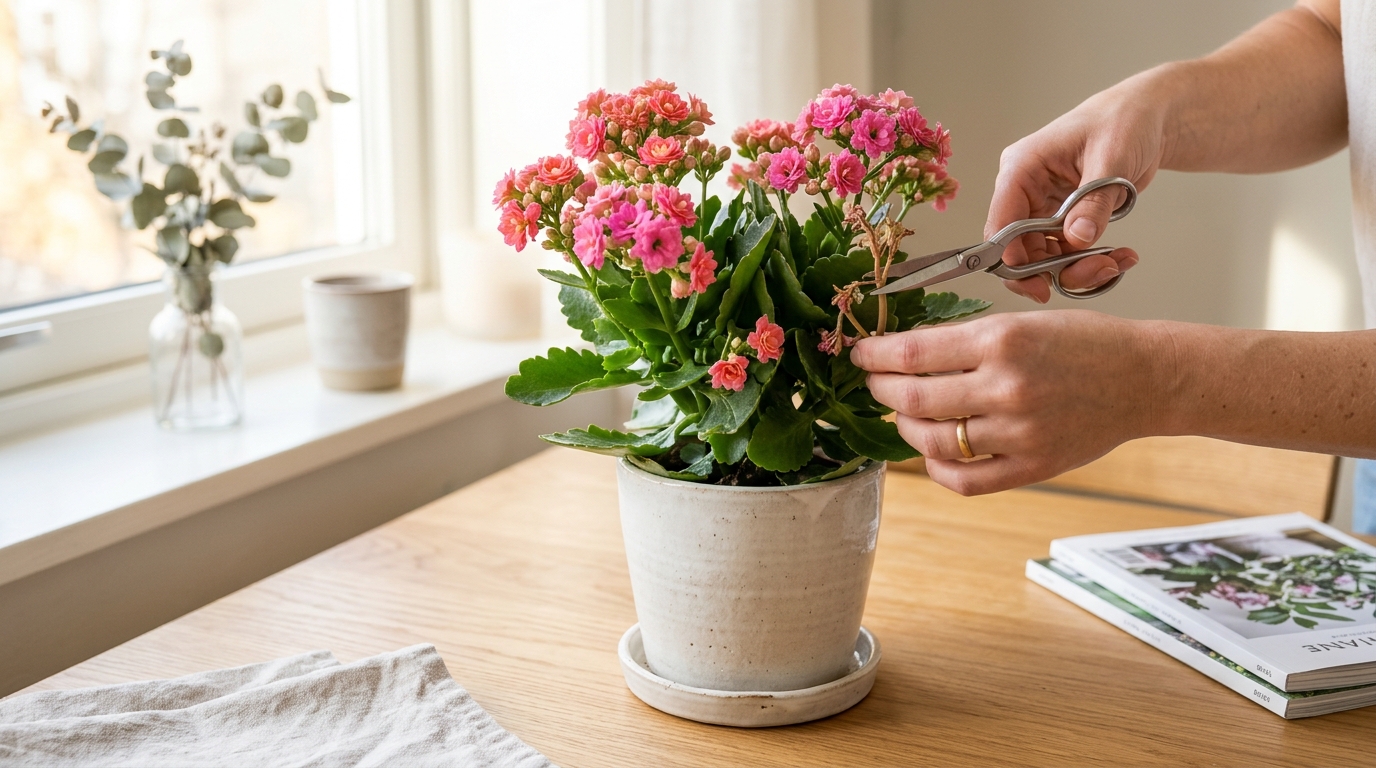
Quick Summary: Pruning your Kalanchoe blossfeldiana (Flaming Katy) is essential after its vibrant flowering season concludes. Deadheading spent flower stems down to the nearest healthy leaf pair redirects energy from seed production into new foliage nodes. For leggy plants, cutting back overextended branches just above a leaf node breaks apical dominance, transforming a scraggly succulent into a lush, bushy showstopper.
When you first bring home a Flaming Katy (Kalanchoe blossfeldiana) from a nursery, it looks like a compact, floriferous bouquet of bright blossoms. However, once the initial 8 to 10-week blooming cycle fades, many plant owners are left puzzled: the flowers wither into dry brown husks, and the central stems begin stretching upward into tall, leggy stalks with sparse foliage.
Pruning is the single most effective cultural practice to revitalize an exhausted Kalanchoe. In this authoritative botanical guide, you will learn exactly when and where to make your cuts, how to deadhead fading flowers without damaging prospective leaf buds, and how to safely shape leggy growth into a dense, bushy plant ready for its next round of blossoms.
Why Pruning Kalanchoe Is Essential
In their native arid habitats across Madagascar, Kalanchoes grow as perennial, semi-woody succulent shrubs. Indoors, without periodic pruning and natural weathering, they exhibit pronounced apical dominance—a hormonal phenomenon where the central terminal bud produces auxins that suppress the growth of lower lateral branches. Left unpruned, Kalanchoes naturally become top-heavy, frail, and aesthetically untidy.
Targeted pruning provides three vital botanical benefits:
- Halts Useless Seed Production: Fading flower heads expend tremendous carbohydrates attempting to produce seed capsules. Cutting them off instantly conserves plant sugars for vegetative recovery.
- Stimulates Lateral Node Branching: Severing a terminal stem prompts dormant lateral nodes (the junctions where leaves meet the main stem) to produce two or three brand-new branching shoots.
- Improves Air Circulation: Thinning out congested or dead interior foliage minimizes micro-climatic humidity traps, dramatically lowering the risk of powdery mildew and botrytis fungal blights.
Essential Tools and Sanitization Preparation
Because Kalanchoes possess succulent, moisture-rich stems, making jagged or unsterilized cuts invites opportunistic fungal pathogens directly into the plant’s vascular tissue. Before making a single cut, prepare the following tools:
- Precision Bypass Pruning Shears or Floral Snips: Avoid anvil pruners, which crush delicate succulent vascular bundles instead of slicing cleanly.
- 70% Isopropyl Alcohol or 10% Bleach Solution: Wipe both cutting blades thoroughly between plants to eliminate pathogen cross-contamination.
- Clean Paper Towels or Cotton Swabs: To blot sap and ensure clean cuts.
- Clean Workspace: Wipe down counters and ensure no diseased plant debris is present.
Step 1: Deadheading Spent Flowers (Post-Bloom Clean-Up)
Deadheading refers to the removal of old, wilting, or brown flower clusters. Follow this precise method:
Inspect the flower stalk. You will notice that the bloom cluster is supported by a slender, semi-woody flower stem that emerges from the uppermost pair of foliage leaves. Trace this flower stalk all the way down to its base, approximately 1/4 inch above the first prominent pair of green leaves. Position your bypass shears at a slight 45-degree angle and make a swift, clean cut.
Crucial Rule: Never pull or twist dead flower heads off by hand. Doing so tears the outer epidermal tissue of the stem, creating ragged wounds that ooze sap and invite bacterial soft rot.
Step 2: Shaping and Correcting Leggy, Etiolated Stems
If your Kalanchoe was kept in low light during its flowering period, its stems will likely have elongated significantly—a condition known as etiolation. Etiolated stems cannot support future flower clusters and will flop over under their own weight.
To restore a compact, bushy mound:
- Identify any stem that extends disproportionately beyond the plant’s natural canopy contour.
- Locate an outward-facing leaf node about 1/3 to 1/2 way down the stem. You want to leave at least 2 to 3 healthy pairs of mature leaves on the remaining lower stalk.
- Make a clean horizontal cut 1/4 inch above the node. Within 10 to 18 days, tiny emerald green buds will emerge from the leaf axils, producing new bushy growth.
- Repeat this selectively across the plant, never removing more than 30% to 35% of the total foliage mass in a single session.
Pruning Quick Reference Guide
Use this reference table to determine the best pruning approach for your specific plant condition:
| Plant Situation | Target Cut Location | Recommended Technique | Expected Recovery |
|---|---|---|---|
| Wilting, brown bloom stalks | Base of bloom stalk, 1/4″ above top leaf pair | 45-degree angle clean cut | Immediate energy redirection |
| Leggy, stretched stems (Etiolation) | 1/3 down stem, above outward-facing leaf node | Horizontal cut leaving 2-3 leaf pairs | New side shoots in 10-18 days |
| Yellowing or diseased lower leaves | Junction with main stem | Flush snip without scoring main bark | Prevents fungal spore spread |
| Mature woody base rejuvenation | Lower 2 to 3 inches above soil line | Staggered cut over 2 seasons | Complete bush renewal in 6-8 weeks |
Bonus: Don’t Throw Away Healthy Pruned Stems!
Healthy pruned stems are prime material for vegetative propagation. Any pruned stem with 2 to 3 pairs of leaves can be transformed into a brand new flowering specimen:
- Strip the lowest pair of leaves to expose 1 to 2 clean nodes.
- Place the cutting in a dry, shaded room for 48 to 72 hours so the severed cut develops a firm, protective callous.
- Insert the calloused cutting 1 inch deep into a 50/50 mix of perlite and cactus potting soil.
- Keep the medium barely moist in bright indirect light. Vigorous new root systems will establish within 2 to 3 weeks!
Post-Pruning Care: Setting Up the Next Bloom
Immediately after pruning, do not overwater your Kalanchoe. Because you have reduced its total leaf area, its transpiration rate temporarily drops. Allow the top 2 inches of potting mix to dry thoroughly between waterings.
Move the pruned plant into a location with generous bright indirect sunlight (or 2-3 hours of gentle morning sun) and feed it with a balanced, half-strength 10-10-10 liquid houseplant fertilizer once a month during spring and summer.
Frequently Asked Questions
When is the best time of year to prune a Kalanchoe?
The ideal time to perform major structural pruning is late winter to early spring, right after the main winter-to-spring bloom cycle finishes. However, light deadheading of fading flowers should be done continuously whenever individual bloom heads dry out.
Will pruning my Kalanchoe stimulate more flowers?
Yes! Kalanchoe flowers develop primarily on the tips of new branch growth. By pruning back old wood and encouraging lateral branching, you create twice as many potential terminal stems capable of carrying flower buds during the next flowering season.
Can I prune a Kalanchoe while it is currently in bloom?
You should avoid heavy pruning while the plant is in full bloom. Only snip off individual spent flower blossoms within a cluster to keep the plant looking tidy. Save structural shaping and stem cutbacks until the entire flower head has finished blooming.
How far down can I safely cut an overgrown Kalanchoe?
You can safely cut stems back by up to 50% of their total length, provided you leave at least 2 or 3 healthy leaf nodes on the remaining base. Stems cut entirely down to bare, leafless woody stumps will take much longer to regenerate and carry a higher risk of root rot.