
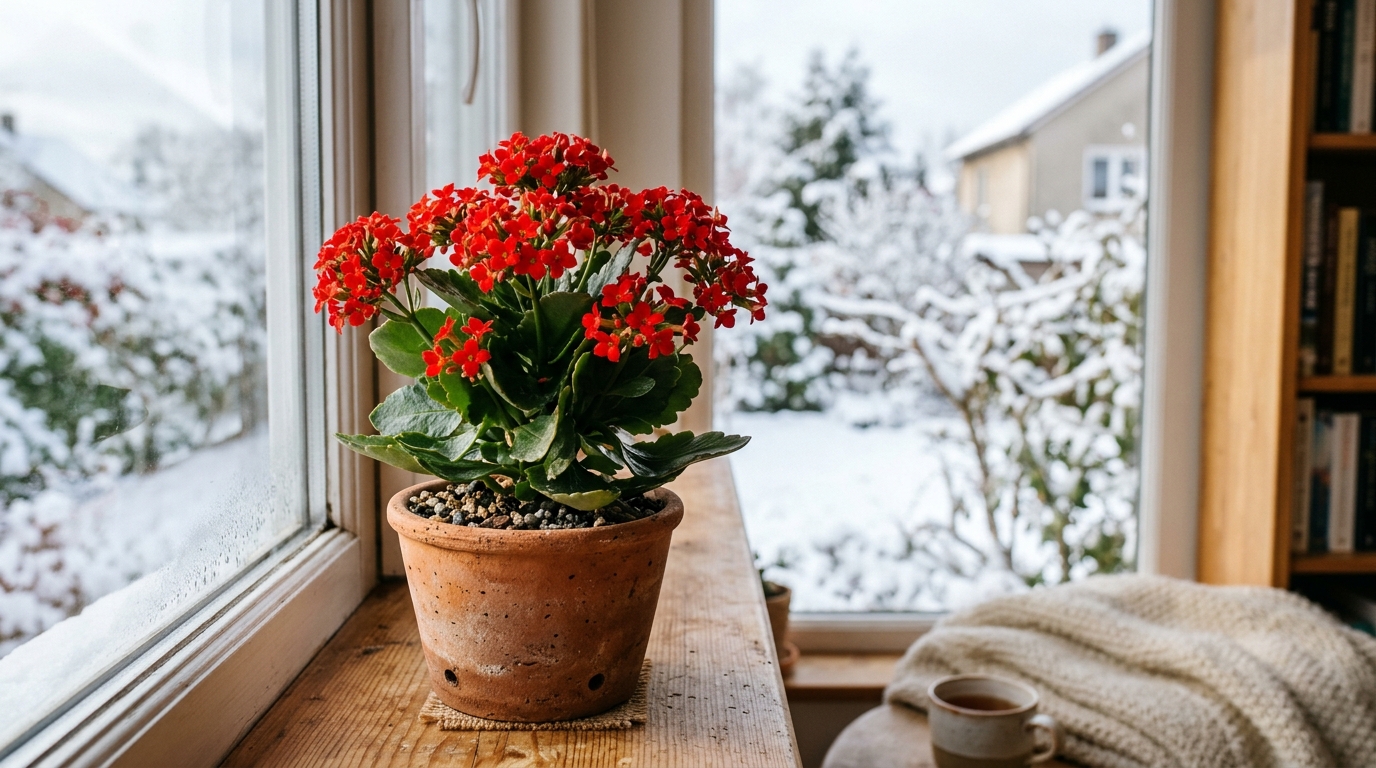
Winter Alert: As tropical succulents native to Madagascar, Kalanchoes have zero frost tolerance. While winter’s naturally shortening days trigger their spectacular floral bud formation, the combination of cold indoor window drafts and moist potting soil causes rapid, irreversible fungal root rot. Maintaining temperatures above 50°F (10°C) and drastically scaling back watering are the twin pillars of winter survival (consult our master Kalanchoe watering guide and full Flaming Katy care guide).
Winter presents a fascinating paradox for Kalanchoe blossfeldiana growers. On one hand, winter is the plant’s natural reproductive prime: shortened day lengths stimulate hormones that produce hundreds of colorful flower buds. On the other hand, the artificial winter home environment—marked by chilly drafts, dry central heating, and scarce natural sunlight—poses significant environmental stress.
If you want your Kalanchoe to survive the cold months and burst into full, radiant blossom in late winter, follow this authoritative seasonal care guide.
Temperature Thresholds: What Kalanchoe Can and Cannot Tolerate
Kalanchoes are classified in USDA Hardiness Zones 10 through 12. Because their thick, fleshy leaves are over 90% water, freezing temperatures cause cellular water to expand and rupture cell walls, turning foliage into black, translucent mush within hours.
- Ideal Winter Daytime Range: 65°F to 75°F (18°C to 24°C).
- Ideal Winter Nighttime Range: 55°F to 62°F (13°C to 17°C). A mild 10-degree nocturnal temperature drop is actually beneficial for bud setting.
- Absolute Minimum Safety Threshold: 50°F (10°C). Prolonged exposure below this threshold halts all metabolic activity.
- Lethal Frost Point: 32°F (0°C) and below. Causes immediate, fatal cellular collapse.
The Deadly Combination: Cold Soil + Moisture
The single greatest cause of Kalanchoe mortality between November and February is the “Cold Feet Syndrome.” In warm summer weather, a thoroughly soaked pot dries within 3 to 5 days through active root uptake and leaf transpiration. In winter, lower ambient temperatures and shorter photoperiods cause the plant’s metabolic rate to slow by up to 70%.
If you water your Kalanchoe on a summer schedule, cold, saturated soil deprives root hairs of oxygen. Fungal soil pathogens like Pythium and Phytophthora proliferate, invading the vascular root system and traveling up into the lower stem, causing sudden stem collapse.
The Golden Winter Watering Rule: Allow at least the top 75% of the potting medium—or the entire pot—to dry out completely between waterings. If in doubt, wait another 3 to 4 days. A slightly thirsty succulent will easily bounce back, but a cold, waterlogged succulent cannot be resurrected.
Troubleshooting Winter Symptoms
Keep this diagnostic table handy during the cold winter months to address issues before they cause permanent harm:
| Winter Symptom | Primary Root Cause | Immediate Corrective Action |
|---|---|---|
| Translucent, mushy, blackened leaves | Freeze shock / cold glass window contact | Cut off mushy leaves; move at least 12 inches away from cold glass |
| Soft, yellowing lower foliage with moist soil | Early-stage winter root rot from overwatering | Withhold water immediately; move to warm, well-ventilated spot |
| Wrinkled, slightly soft leaves with bone-dry soil | Normal succulent dehydration | Give a modest bottom watering with lukewarm water |
| Flower buds dry up and fall off without opening (bud blast) | Cold drafts or hot radiator airflow | Relocate away from heating vents and exterior entrance doors |
Lighting Strategies for Short Winter Days
Winter sun is weaker and sits lower on the horizon. A spot that provided ideal bright indirect light in June may become too dim by December. In winter, move your Kalanchoe directly into your sunniest window—typically a south-facing or unobstructed west-facing sill.
If your home suffers from persistent gloomy winter skies, supplement with an affordable 6500K full-spectrum LED grow light placed 10 to 12 inches above the canopy for 8 to 10 hours daily. This preserves leaf density, prevents stem stretching, and ensures robust floral pigment development.
Winter Feeding: Put Away the Fertilizer
Do not fertilize your Kalanchoe during late autumn and winter. The plant’s reduced metabolic activity means unabsorbed fertilizer salts will accumulate around dormant root hairs, resulting in chemical root burn. Resume light feeding in early spring when vigorous new vegetative growth resumes.
Frequently Asked Questions
Can my Kalanchoe touch the window glass in winter?
No! Window panes can drop to near-freezing temperatures on winter nights, even in well-heated rooms. Any succulent leaf resting directly against cold glass will suffer immediate localized frostbite. Keep your pot at least 6 to 12 inches back from window panes.
Should I mist my Kalanchoe in winter because the air is dry?
Never mist a Kalanchoe! Kalanchoes are desert-adapted succulents that thrive in standard low indoor humidity (30% to 50%). Misting traps water between thick leaves and inside flower clusters, creating the exact micro-climate needed for powdery mildew and gray mold.
What temperature water should I use when watering in winter?
Always use room-temperature or lukewarm water (around 68°F to 72°F / 20°C to 22°C). Cold tap water straight from outdoor pipes in winter shocks tropical succulent root systems, triggering premature leaf drop and root vascular spasms.