
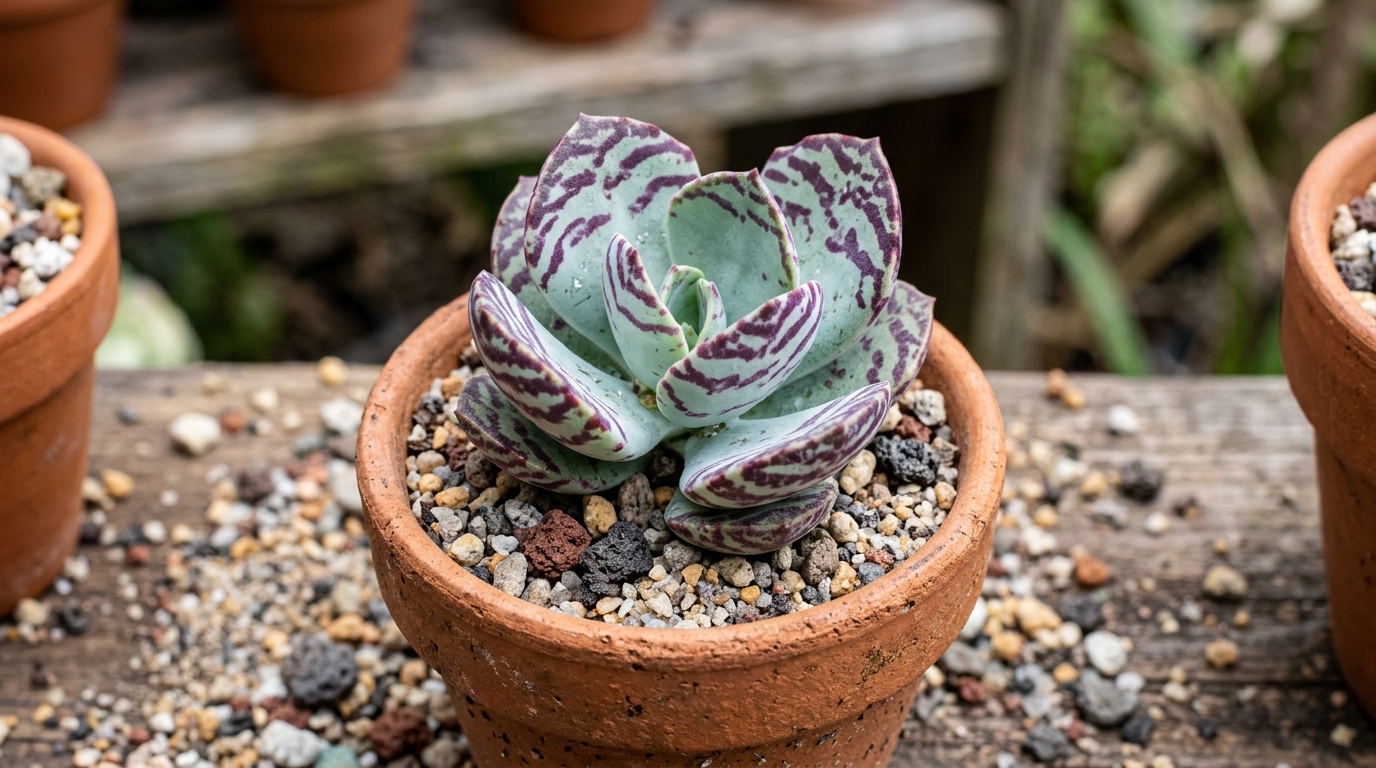
Variety Profile: Kalanchoe humilis, widely celebrated by the cultivar name Desert Surprise, is a compact, dwarf succulent endemic to the rocky, sun-drenched hills of Tanzania, Malawi, and Mozambique. It is famous for its spoon-shaped, powdery blue-green leaves adorned with dramatic purple, maroon, and burgundy zebra bands. Pair this dwarf treasure with care insights from our Flaming Katy care guide and our seasonal Kalanchoe watering guide.
For houseplant collectors with limited windowsill space, Kalanchoe humilis (Desert Surprise) is a miniature dream plant. Rarely exceeding 6 to 8 inches in height, this low-growing perennial succulent produces rosettes of thick, paddle-like leaves etched with deep purple tiger striping that looks painted on by hand.
However, many growers find that after bringing their plant home, the magnificent purple stripes begin to fade into plain green, and the rosette stretches into a weak stalk. In this focused care guide, you will learn how to preserve its vivid zebra striping and maintain a healthy, compact plant for years to come.
The Secret to Vivid Purple Zebra Stripes: Light Intensity
The hallmark maroon and burgundy bands on Kalanchoe humilis are an adaptive coloration. The purple pigments (anthocyanins) act as natural UV shields that prevent solar damage to the plant’s chloroplasts in high-altitude African rock crevices.
When the plant is kept in low or moderate light, it no longer needs this UV protection. To maximize photosynthesis in the dim environment, the plant stops producing anthocyanins and expands green chlorophyll across the entire leaf blade. Within 4 to 6 weeks of dim light, the purple stripes vanish completely!
How to Keep the Stripes Bold: Place your Kalanchoe humilis in your brightest window, ideally receiving at least 3 to 5 hours of direct morning or late-afternoon sunshine. In winter or gloomy climates, a 20-watt full-spectrum LED grow light placed 8 inches away will keep the zebra striping crisp, dark, and vibrant.
Watering and Substrate: The Low-Moisture Mandate
Because Kalanchoe humilis is a dwarf succulent that grows in narrow rock crevices, its root system is relatively shallow and extremely intolerant of soggy potting soil. Follow these rules:
- Use Extremely Gritty Mix: Standard houseplant soil will rot this plant. Use a blend of 40% commercial cactus soil, 40% coarse pumice or perlite, and 20% coarse horticultural sand or granite grit.
- Soak and Dry Completely: Water deeply until water runs through the drainage hole, then allow the pot to become 100% bone-dry before watering again. In winter, water only once every 3 to 4 weeks.
- Choose Terracotta: Unglazed porous terracotta pots allow moisture to evaporate through pot walls, ensuring roots dry quickly.
Foliage Variation Quick Guide
Use this diagnostic guide to read your Kalanchoe humilis foliage health:
| Foliage Appearance | Plant Health Condition | Action Required |
|---|---|---|
| Deep chalky blue with bold purple/maroon stripes | Optimal health, perfect light balance | Maintain current care routine |
| Pale green leaves, stripes fading or disappearing | Insufficient light exposure | Acclimate to direct sun or add an LED grow light |
| Soft, wrinkled leaves that feel rubbery | Natural dehydration (water deficit) | Give a thorough soaking; leaves plump back up within 24 hours |
| Yellowing lower leaves with black stem base | Early-stage root rot from overwatering | Unpot immediately, trim rotted roots, and repot in dry pumice |
Frequently Asked Questions
How big does Kalanchoe humilis get?
Kalanchoe humilis is a miniature to dwarf species. The vegetative rosette typically reaches only 4 to 8 inches (10 to 20 cm) in height and width, making it one of the most compact and tidy Kalanchoes available for indoor cultivation.
What do Kalanchoe humilis flowers look like?
In spring or early summer, the plant produces a tall, branched flower inflorescence reaching up to 12 to 18 inches high. The small blossoms are purple-tinted green with reddish-violet veins. While attractive, the plant is primarily cultivated for its sensational striped foliage.
Can Kalanchoe humilis be propagated from single leaves?
Yes! Like most Crassulaceae, healthy mature leaves gently twisted from the stem will callous within 3 days and root on dry cactus mix within 3 to 4 weeks. As the plant matures, it also produces small basal offsets that can be easily separated during spring repotting.