
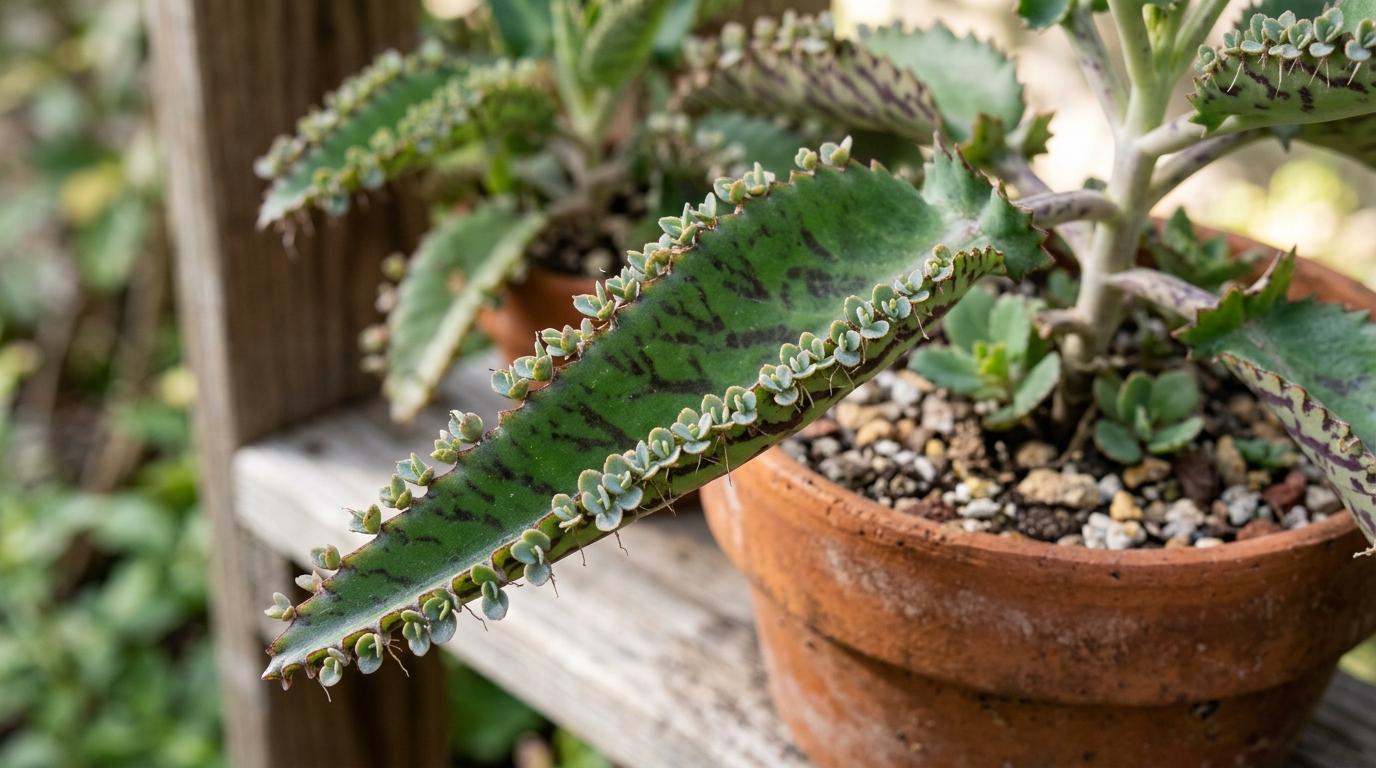
Variety Profile: Kalanchoe daigremontiana (often classified as Bryophyllum daigremontianum), known worldwide as the Mother of Thousands or Alligator Plant, possesses one of the most astonishing reproductive strategies in the plant kingdom: it produces dozens of fully formed miniature plantlets along the serrated margins of its dagger-shaped leaves. While following general principles from our Flaming Katy care guide, handle plantlets with caution: read our Kalanchoe propagation guide and review pet risks in our pet toxicity report.
Few plants ignite curiosity quite like the Mother of Thousands (Kalanchoe daigremontiana). Originating from the semi-arid Fiherenana river valley in southwestern Madagascar, this bizarre succulent doesn’t rely solely on conventional flowering and seeds for reproduction. Instead, it turns its own foliage into a living nursery.
With narrow, serrated green leaves marbled with purple tiger stripes underneath and lined with hundreds of tiny miniature rosettes, it is a botanical masterpiece. However, its explosive reproductive vigor requires responsible indoor management. Here is your definitive care and containment guide.
The Wonder of Epiphyllous Plantlets
The tiny clones that fringe the margins of Kalanchoe daigremontiana are known scientifically as epiphyllous plantlets. At each notch along the leaf serrations, meristematic tissue differentiates to produce complete miniature plants, complete with tiny leaves and miniature airborne rootlets, while still physically attached to the mother leaf.
When the plantlets reach maturity, or when the leaf is brushed by a passing breeze or animal, the plantlets release their hold and drop to the ground. The moment they contact moist soil, their pre-formed roots anchor instantly, establishing a brand-new clonal specimen.
Essential Containment & Responsible Growing Rules
Because every single dropped plantlet can grow into a mature plant, Kalanchoe daigremontiana is classified as an invasive species in frost-free regions such as Florida, Hawaii, and parts of Australia. If you live in USDA Hardiness Zones 9b through 12, never plant Mother of Thousands directly in outdoor garden beds.
For indoor houseplant enthusiasts, follow these smart containment guidelines:
- Pot Solo: Never plant Mother of Thousands in a shared container or mixed succulent arrangement. It will rapidly drop plantlets into neighboring root zones and outcompete other succulents.
- Keep Clear of Neighboring Pots: Place the pot at least 12 inches away from other houseplants to prevent falling plantlets from landing in adjacent containers.
- Harvest Plantlets Regularly: If you do not want an army of new plants, simply brush excess plantlets off the leaves directly into the compost or trash bin with a gloved hand.
Core Care Requirements
1. Light: Sun Creates Bold Tiger Stripes
Mother of Thousands requires bright, direct to filtered sunlight (at least 4 to 6 hours daily). Under strong light, the underside of the leaves develops dramatic purple-brown mottling resembling alligator skin. In low light, the stems become weak, floppy, and prone to snapping.
2. Watering & Soil
Like its cousin Flaming Katy, Mother of Thousands stores substantial water reserves in its thick stems and fleshy leaves. Allow the potting soil to dry out completely between waterings. Use a gritty, well-draining cactus mix blended with 30% perlite or pumice to prevent basal stem rot.
Toxicity Warning for Cat and Dog Owners
All parts of Kalanchoe daigremontiana, and especially the tiny plantlets, contain high concentrations of a cardiac glycoside known as daigremontianin. If chewed or swallowed by pets, it can trigger severe drooling, vomiting, diarrhea, lethargy, and in serious cases, cardiac arrhythmia. Always display this plant on high shelves or hanging plant stands entirely out of reach of pets.
Frequently Asked Questions
What is the difference between Mother of Thousands and Mother of Millions?
While both produce clonal plantlets, Mother of Thousands (K. daigremontiana) has broad, triangular, dagger-shaped leaves with plantlets lining the entire leaf margin. Mother of Millions (Kalanchoe delagoensis / tubiflora) features narrow, cylindrical, pencil-like tubular leaves with plantlets clustered only at the very tips.
How do I root the fallen plantlets?
Rooting is effortless. Gather fallen plantlets and gently place them on the surface of slightly damp succulent potting soil. Place the pot in bright indirect light and mist lightly once a week. The tiny roots will burrow into the soil within 7 to 10 days.
Does Mother of Thousands bloom?
Yes! In winter, mature plants send up an umbrella-like cluster of pendulous, bell-shaped flowers in shades of coral-pink and gray-violet. Like many related species, blooming takes substantial energy, and the blooming stem will gradually decline while new plantlets carry on.